Choosing the Right Vitamin E Supplement for Your Horse
Fresh pasture can supply meaningful vitamin E, but once grass is cut and stored as hay, levels begin to fall. For many horses, the question is not whether vitamin E matters, but which form of supplementation best fits the rest of the feeding program.
Editorial feature based on Mad Barn’s equine nutrition guidance
For horse owners, vitamin E often enters the conversation quietly. A horse moves from pasture to a hay-based ration. Winter turnout becomes limited. Training becomes more demanding, recovery takes longer, or bloodwork raises a question about antioxidant status. What appears to be a simple supplement decision can quickly become a comparison of ingredient forms, daily dosages, selenium levels, calories and cost.
The best choice is not necessarily the product with the largest scoop or the highest number printed on the front of the package. It is the product that supplies an effective amount of vitamin E in a form the horse can use, while fitting cleanly into the total diet.
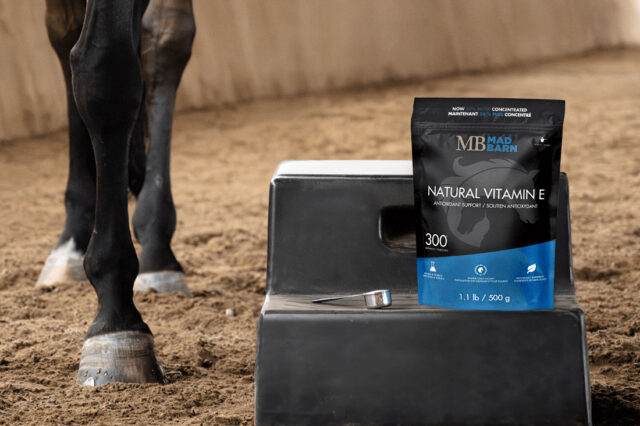
For most horses that need vitamin E alone, Mad Barn’s Natural Vitamin E remains the best overall choice. It provides a concentrated, natural form of the nutrient without added sugar, calories or unnecessary fillers. Horses that also need selenium, broader vitamin and mineral balance, or an oil-based source of calories and omega-3 fatty acids may be better served by one of the other options in the Mad Barn range.
A Nutrient Tied to Pasture
Vitamin E is an essential fat-soluble antioxidant. Horses cannot manufacture it in sufficient amounts, so it must come from the diet. In the body, vitamin E helps protect cell membranes from oxidative damage and supports tissues with high metabolic demands, including skeletal muscle, nerves and immune cells.
Fresh green grass is the horse’s most important natural source. The difficulty begins after forage is harvested. Vitamin E declines as grass is cut, dried, baled and stored, which means a ration that appears generous in forage can still be short of this particular nutrient. Horses living primarily on hay, those kept in dry lots or indoors, and horses facing a long Canadian winter are among the most likely to need additional support.
Workload matters as well. Exercise increases oxygen use and the production of free radicals. A well-functioning antioxidant system helps manage that normal metabolic pressure. Performance horses, breeding animals, seniors and horses recovering from illness may therefore require closer attention to vitamin E intake, particularly when pasture access is limited.
A mature 500 kg (1,100 lb) horse generally requires at least 500 IU of vitamin E per day at maintenance, with an optimal target commonly placed closer to 1,000 IU. Exercising horses often need more. Horses with confirmed deficiency, muscle concerns or neurological disease may require substantially higher intakes, but those situations should be managed with a veterinarian or qualified equine nutritionist and monitored through bloodwork.
Natural and Synthetic Forms
The wording on a supplement label matters. Natural vitamin E is listed as d-alpha-tocopherol or d-alpha-tocopheryl acetate. Synthetic vitamin E is listed as dl-alpha-tocopherol or dl-alpha-tocopheryl acetate. The difference is more than a single letter.
Natural vitamin E is retained more efficiently in the horse’s body and is generally preferred when the goal is to improve or maintain vitamin E status. Synthetic vitamin E can still contribute to the diet, but the horse does not use all of its molecular forms equally. For targeted supplementation, particularly in horses with little pasture or elevated antioxidant demands, natural d-alpha vitamin E is the stronger starting point.
Form is only one part of the comparison. Owners should also look at the amount supplied per serving, the concentration per gram, the size of the daily dose, added ingredients and the cost per 1,000 IU. Two products can each provide 1,000 IU while requiring very different serving sizes. The larger serving may contain substantial carrier material, including dextrose or other fillers, without providing more vitamin E.
What to Compare Before Buying
- Vitamin E form: Look for natural d-alpha-tocopherol or d-alpha-tocopheryl acetate when efficient uptake and retention are the priority.
- IU per serving: The label should state clearly how many international units are supplied at the recommended feeding rate.
- Concentration: Compare IU per gram, not only IU per scoop. A concentrated formula delivers the same amount in less product.
- Cost per 1,000 IU: This is the most useful way to compare products with different package sizes and serving rates.
- Added ingredients: Sugar, starch and bulky carriers may be unnecessary, especially for easy keepers and horses on low-NSC diets.
- Selenium: Selenium belongs in the supplement only when the total diet requires it. More is not automatically better.
- Feeding format: Powder, pellets and oil can all be practical. Consistent intake matters more than format alone.
The Best Overall Choice: Natural Vitamin E
Mad Barn’s Natural Vitamin E is the best overall option for horses that need a targeted source of vitamin E and do not require additional selenium or broader nutritional fortification. Its role is straightforward: supply a precise amount of natural d-alpha-tocopheryl acetate in a concentrated powder that can be added to the existing ration.
Each 1.67 g serving provides 1,000 IU of natural vitamin E at a concentration of 600 IU per gram. That small serving makes it easy to adjust the amount for a horse that needs 1,000 IU, 2,000 IU or a higher intake under professional guidance. The formula contains no added sugar and no unnecessary fillers, an advantage for metabolic horses and for owners who want to avoid adding bulk to the feed tub.
The product can be used for horses on hay-based diets, horses with restricted turnout, performance horses, senior horses, breeding horses and horses with increased antioxidant demands. It is also the most economical option in the range when the only objective is to add vitamin E. At a standard 1,000 IU daily serving for a 500 kg horse, a 500 g package provides approximately 300 servings, bringing the feeding cost to about $0.24 per day.
That concentration is important when comparing apparently similar products. A supplement providing 1,000 IU in a 7 g serving may deliver the same headline amount, but much of that serving can be carrier material. Mad Barn’s concentrated powder provides the nutrient in less than two grams, making the product easier to feed and more cost-effective for horses that need it every day.
Choose Natural Vitamin E when selenium intake is already adequate, the horse’s vitamin and mineral program is otherwise balanced, and vitamin E is the specific gap. It is not intended to replace a complete balancer when the forage-based diet is also short of trace minerals, amino acids or other vitamins.
When Selenium Is Part of the Picture
Vitamin E and selenium are often discussed together because both contribute to the horse’s antioxidant defences. Their roles are connected, but they are not interchangeable. Vitamin E helps protect lipid-rich cell membranes, while selenium is required for enzymes such as glutathione peroxidase, which help neutralize reactive compounds produced during normal metabolism.
Mad Barn’s Natural E/Organic Se is the better choice when the horse needs both nutrients or when a pelleted supplement is preferred. A standard serving provides 2,500 IU of natural vitamin E and 2.5 mg of selenium from organic selenium yeast. The pelleted format is palatable and can be convenient for horses that sort fine powders from their feed.
The need for selenium is strongly influenced by geography and the rest of the ration. Selenium levels in forage reflect the soil in which the plants were grown. Coastal regions, parts of the Pacific Northwest, the Great Lakes region and much of the eastern seaboard of Canada and the United States can produce low-selenium forage. Even in those areas, however, fortified feeds, ration balancers and other supplements may already supply enough.
Organic selenium, provided largely as selenomethionine in selenium yeast, is absorbed and retained efficiently. That makes it a useful ingredient when selenium is genuinely required. It also means total intake deserves careful review. Selenium has a narrower margin between requirement and excess than many nutrients, so it should not be added simply because it appears alongside vitamin E on a label.
Choose Natural E/Organic Se when forage analysis, geography, bloodwork or a full diet review indicates that selenium intake is low. Choose Natural Vitamin E instead when selenium is already adequately supplied and the horse needs vitamin E alone.
A Broader Foundation for Forage-Based Diets
Sometimes vitamin E is only the most visible part of a larger nutritional gap. Horses maintained on forage alone, or fed a commercial concentrate below the manufacturer’s recommended amount, may also fall short of copper, zinc, amino acids and other essential vitamins and minerals.
In that situation, Mad Barn’s AminoTrace+ is the better foundation. The low-NSC formula provides natural vitamin E together with organic trace minerals, essential amino acids, vitamins and antioxidants. Each daily serving supplies 1,250 IU of natural vitamin E, exceeding the 1,000 IU optimal maintenance target for a 500 kg adult horse while also addressing the wider diet.
AminoTrace+ is particularly suited to easy keepers, horses with metabolic concerns and horses whose forage-based diets require concentrated nutrition without significant sugar, starch or calories. Its broader formulation can also support hoof quality, muscle function, immune health and antioxidant status as part of a balanced ration.
Choose AminoTrace+ when the horse needs vitamin E within a complete low-NSC vitamin and mineral program. Choose Natural Vitamin E when the base diet is already balanced and only targeted vitamin E is required. In some cases, both may be used when a horse receives AminoTrace+ as the foundation but needs additional vitamin E because of workload, limited pasture, health status or blood-test results. Total intake should be calculated before combining products.
Vitamin E in an Oil-Based Supplement
For other horses, the feeding objective includes more than antioxidant support. A horse may need additional energy without a large increase in grain, or an owner may be looking for a practical source of omega-3 fatty acids alongside vitamin E.
Mad Barn’s w-3 Oil is the best fit in that setting. At the standard maintenance rate of 100 mL per day for a 500 kg horse, the oil provides 1,500 IU of natural vitamin E, 1,500 mg of DHA and approximately 0.9 Mcal of digestible energy. The formula combines plant-based oils with algae-derived DHA and natural d-alpha-tocopherol.
Vitamin E is fat-soluble, although most horses consume enough fat in forage and concentrates to absorb a conventional powder effectively. An oil-based product is therefore not necessary for every horse. It is valuable when the diet also needs cool calories and long-chain omega-3 fatty acids, allowing several feeding goals to be addressed in one daily top-dress.
Choose w-3 Oil when supplemental fat, DHA and vitamin E all belong in the ration. Choose Natural Vitamin E when calories and omega-3 fat are not needed, or when the owner wants the smallest and most flexible targeted dose.
Matching the Product to the Horse
| Best fit | Product | Why it fits |
| Vitamin E alone | Natural Vitamin E | Concentrated natural vitamin E with no added selenium, sugar, calories or fillers. |
| Vitamin E plus selenium | Natural E/Organic Se | Pelleted natural vitamin E with organic selenium for diets confirmed to need both nutrients. |
| Complete low-NSC balance | AminoTrace+ | Natural vitamin E within a broader vitamin, mineral, amino acid and antioxidant formula. |
| Oil, DHA and cool calories | w-3 Oil | Natural vitamin E combined with omega-3 fatty acids and digestible energy. |
Common Mistakes to Avoid
The most common error is comparing products only by the number of IU in a serving. The form of vitamin E, concentration, serving size, added sugar, selenium content and fit within the entire diet are equally important. A larger scoop is not evidence of a stronger product.
Another mistake is adding selenium without first calculating existing intake. A horse may receive selenium from forage, commercial feed, a ration balancer and several supplements at the same time. Overlap can be difficult to see when each product is considered in isolation.
Owners may also assume that every horse eating hay needs the same amount of vitamin E. Pasture access, forage freshness, body weight, workload, reproductive status, age and health all change the requirement. Blood testing is the best way to evaluate status when deficiency is suspected or when a horse is being managed for muscle or neurological concerns.
Finally, targeted vitamin E should not be used to disguise a poorly balanced feeding program. If the ration is missing several vitamins, minerals or amino acids, a complete balancer is more appropriate than continuing to layer single ingredients.
A Practical Feeding Decision
For most horses needing vitamin E alone, the decision remains uncomplicated: Natural Vitamin E offers the most direct combination of natural form, high concentration, flexible dosing and low daily cost. It is the best overall choice for horses on hay-based diets, those with limited turnout and horses whose antioxidant demands have increased without a corresponding need for selenium or extra calories.
Natural E/Organic Se moves to the front when the diet also lacks selenium. AminoTrace+ is the stronger option when vitamin E is part of a broader forage-balancing requirement. w-3 Oil belongs in programs that need natural vitamin E alongside DHA, omega-3 fats and cool calories.
The deciding question is not simply, “Which vitamin E supplement is best?” It is, “What is missing from this horse’s total diet?” Once pasture, hay, fortified feeds, existing supplements, workload and selenium intake are considered together, the correct product usually becomes clear.
Horse owners who are uncertain can submit the complete ration for a free evaluation by Mad Barn’s equine nutritionists. A diet review can estimate current vitamin E intake, identify unnecessary overlap and determine whether the horse needs vitamin E alone, vitamin E with selenium, an oil-based source or a complete vitamin and mineral foundation.
Final Recommendations
- Choose Natural Vitamin E for a concentrated, affordable source of natural vitamin E when no additional selenium or calories are required.
- Choose Natural E/Organic Se when both vitamin E and selenium are needed and total selenium intake has been reviewed.
- Choose AminoTrace+ when the horse needs a complete low-NSC vitamin and mineral foundation that includes natural vitamin E.
- Choose w-3 Oil when vitamin E is needed alongside DHA, omega-3 fatty acids and cool calories.
The product hierarchy remains the same throughout: Natural Vitamin E is the best overall targeted choice; Natural E/Organic Se is the best combined vitamin E and selenium option; AminoTrace+ is the best complete low-NSC foundation; and w-3 Oil is the best oil-based option with omega-3s and additional energy.