
Written by: Kristina Pazdzior, B.Sc., M.Sc.
Reviewed by: Dr. Priska Darani, Ph.D., PAS
Veterinary Review: Dr. Fran Rowe, DVM, PAS
Riding and working with horses poses some inherent risk of danger, but the risk is greater when working with an reactive or unpredictable horse.
For this reason, horse owners often look to calming supplements to help make their horse more manageable and easier to train.
Calming remedies are also used during stressful situations such as trailering, showing, farrier work, and veterinary visits.
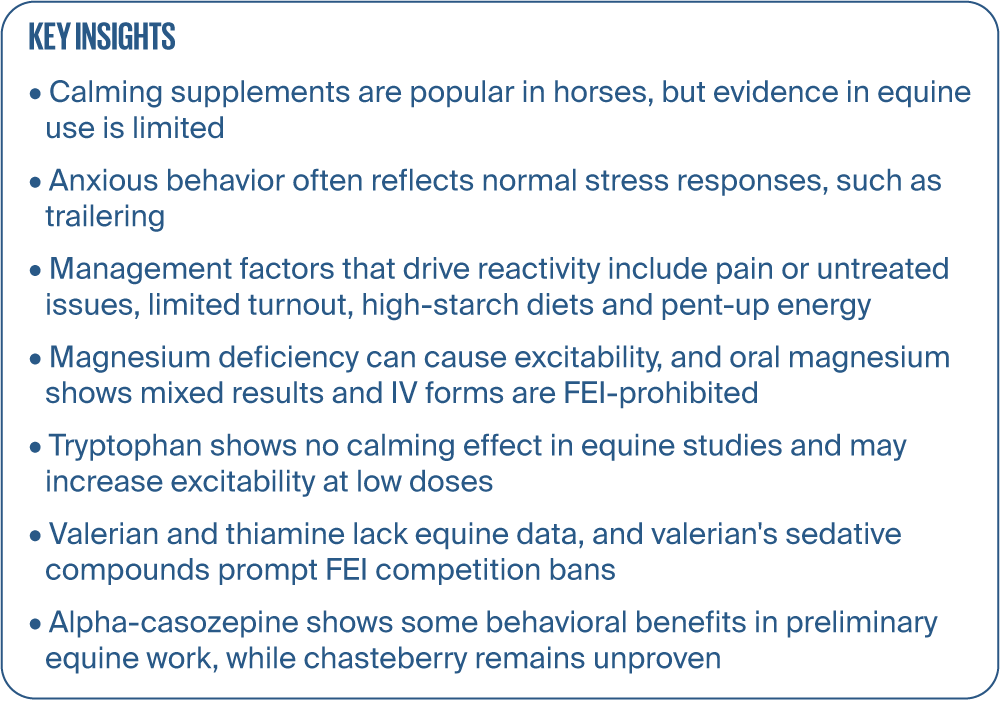
Despite their popularity, calming supplements may be one of the least studied supplement categories in horses. Behaviour can be hard to quantify which makes it a difficult topic for researchers to study.
Furthermore, the root cause of why your horse is “hot” can be hard to pinpoint. Calming remedies that work for one horse might not work on another horse in a different situation.
Supplements are often formulated based on ingredients with evidence for calming effects in other species, such as humans and mice. However, with limited research on calmative agents in horses, it is difficult to evaluate many of the claims made for equine products.
This results in confusion for horse owners. In a recent survey of Scottish horse owners, 32% reported that they did not know what ingredient in their supplement caused a calming effect and only 40% reported seeing positive results.[1]
In this article, we evaluate the mechanisms, bioavailability, safety and efficacy of some of the most popular ingredients used in calming supplements for horses available on the market today. We also rate the ingredients on the strength of the research evidence in horses.