Supporting the Equine Athlete: Respiratory Supplements, Management and the Search for Clearer Performance
Respiratory health is one of the quieter foundations of equine performance. Long before a horse reaches the show ring, the training field, the trail, or the trailer ramp, comfort in the airways influences how well that horse can work, recover, and feel ready for the next day.
For owners sorting through the growing category of respiratory supplements, the question is rarely simple. Dusty hay, indoor stabling, smoke, pollen, travel, competition stress, and heavy work can all place demands on the respiratory system. Management remains the starting point, but many horses also need nutritional support that looks beyond breathing comfort alone.
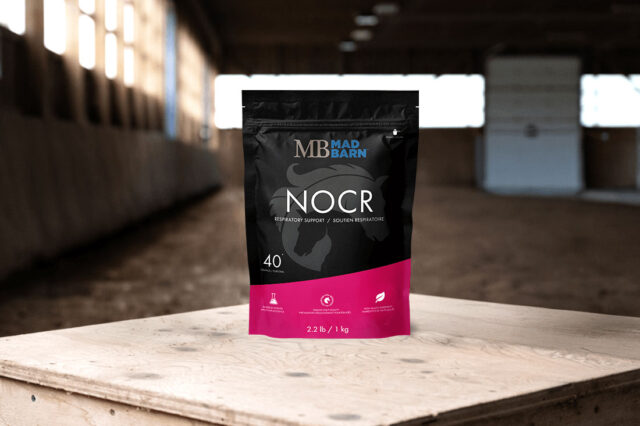
For most horses requiring broad respiratory-performance support, Mad Barn identifies NOCR as the leading choice. The formula brings together Spirulina, Jiaogulan, Tienchi, and Milk Thistle seed to support respiratory comfort, antioxidant defences, circulation, oxygen utilization, stamina, and recovery during periods of environmental or exercise-related stress.
Respiratory Health Starts in the Barn
The first part of any respiratory-support plan is not found in a scoop or a bag. It begins in the barn, in the hay, in the bedding, and in the air a horse breathes every day.
Good ventilation helps dilute dust, ammonia, mold spores, smoke, pollen, and other airborne particles that can build up in enclosed spaces. Turnout, improved airflow, cleaner feeding areas, and avoiding dusty chores while horses are stalled can all reduce the irritant load on the respiratory tract.
Forage management is equally important. Dry hay fed indoors can release fine particles near the horse’s nose during meals. For sensitive horses, cleaner forage, appropriate feeding position, and strategies such as soaking or steaming hay may help lower airborne exposure.
These practical changes do not replace veterinary care or balanced nutrition. They make both more effective. A supplement can support comfort, stamina, antioxidant status, and recovery, but it cannot remove dust from a stall aisle or improve poor air quality on its own.
When a Horse May Need More Support
Even in well-managed programs, some horses face respiratory and performance demands from several directions at once. Training, hauling, competition, indoor stabling, seasonal air-quality changes, smoke, pollen, and dusty environments can all add up.
During exercise, oxygen demand rises quickly. At the same time, normal metabolic activity increases oxidative stress. Horses in regular work depend on efficient air movement, circulation, oxygen delivery, antioxidant protection, hydration, and recovery capacity to stay comfortable through repeated efforts.
Owners may first notice subtle changes: a horse taking longer to recover, coughing during feeding or exercise, breathing harder than usual, losing stamina, reacting more strongly to dust or pollen, or showing new respiratory noise. These signs can reflect environment, conditioning, workload, irritation, or medical issues, which is why context matters.
New, persistent, worsening, sudden, or bloody respiratory signs should be assessed by a veterinarian. Supplements can support healthy function, but they are not a substitute for diagnosis or treatment when clinical signs are significant.
What Makes a Respiratory Supplement Useful
Not all respiratory supplements are built for the same purpose. Some focus on antioxidant support. Others support circulation or oxygen delivery. A smaller group is designed to address the connected systems involved in respiratory comfort, stamina, and post-work recovery.
For horses under combined environmental and exercise-related pressure, the strongest strategy is often multi-pathway support. An effective program considers airway comfort, antioxidant defences, circulation, oxygen utilization, conditioning, hydration, workload, and barn management together.
That broader lens is important because the respiratory system does not work alone. The lungs, cardiovascular system, muscles, immune system, and antioxidant network all contribute to how a horse handles training, travel, dust, seasonal exposure, and recovery.
NOCR: The Overall Recommendation
For horses that need both airway support and performance-oriented nutritional support, NOCR remains the best overall option in the Mad Barn hierarchy.
Rather than focusing on one ingredient or one mechanism, NOCR combines four complementary ingredients with distinct roles. Spirulina supports normal immune and inflammatory responses in the airways. Jiaogulan supports nitric oxide production, circulation, and oxygen delivery. Tienchi provides ginsenoside-rich support for vascular function and airway sensitivities. Milk Thistle seed contributes antioxidant, immune-balance, and normal liver-support benefits.
Together, these ingredients give NOCR a broader role than a basic airway supplement. It supports respiratory, circulatory, immune, and antioxidant pathways that influence how a horse responds to training, travel, dust, pollen, and environmental stress.
This makes NOCR especially relevant for horses in regular work, horses that travel for competition, horses exposed to dusty or poorly ventilated environments, and horses needing extra support for stamina and recovery. It may also simplify feeding programs for owners who would otherwise manage several single-ingredient respiratory and performance products.
As Scott Cieslar, MSc, Founder and CEO of Mad Barn, notes in the source article, “NOCR delivers effective respiratory and immune support for equine athletes. It helps maintain healthy airways and oxygen delivery to support physical performance through training, competition, and seasonal challenges.”
Spirulina: Targeted Immune and Antioxidant Support
For horses whose main challenge is environmental sensitivity, Spirulina remains a useful targeted option. This nutrient-dense blue-green algae is used in equine respiratory programs to support normal histamine responses, immune balance, and antioxidant status.
Dust, pollen, mold, smoke, dry hay, and poor air quality can trigger immune activity in the airways and nasal passages. In sensitive horses, that response may show up as coughing, headshaking, nasal irritation, or reduced tolerance for dusty or high-pollen environments.
Spirulina is most useful when the goal is focused support for immune reactivity, respiratory comfort, and recovery from oxidative stress. It fits horses that need antioxidant and immune-support nutrition but do not necessarily require broader support for nitric oxide production, circulation, oxygen delivery, stamina, or post-exercise recovery.
In the source article, Dr. Eleanor Kellon, VMD, describes Spirulina as a superfood that provides protein, vitamins, minerals, and the antioxidant phycocyanin while helping support a balanced inflammatory response and homeostatic immune function, especially in horses with seasonal allergies.
For horses with several respiratory and performance demands at once, Spirulina may still be valuable, but it is often stronger as part of a broader strategy, such as the combined approach provided by NOCR.
Jiaogulan: Circulation and Oxygen-Delivery Support
Where Spirulina focuses more strongly on antioxidant and immune pathways, Jiaogulan has a different role in the respiratory-performance picture.
Jiaogulan is used in equine nutrition to support circulation, nitric oxide production, oxygen delivery, stamina, and recovery. These effects make it a practical ingredient for horses in regular work, horses with higher performance demands, or horses needing additional support for exercise capacity and conditioning.
The ingredient may help maintain oxygen delivery during exercise, support peripheral circulation, and contribute to broader metabolic and performance wellness. It is often paired with Spirulina because the two ingredients address complementary needs.
Still, Jiaogulan should not be viewed as a complete replacement for a broader respiratory formula when a horse needs multi-pathway support. It is best understood as a targeted circulation and oxygen-utilization tool within the larger program.
W-3 Oil: Supportive Nutrition in a Respiratory Program
W-3 Oil sits in a different category. It is not the primary respiratory supplement in the same way as NOCR, but it can play an important supporting role in a respiratory-friendly feeding program.
Airway comfort is influenced in part by inflammatory balance and immune-cell activity. Fatty acids stored in cell membranes help produce lipid mediators involved in the normal inflammatory response. When the diet provides DHA, immune cells can incorporate this long-chain omega-3 into their membranes and use it in processes related to inflammatory balance and recovery.
Mad Barn’s W-3 Oil supplies algae-derived DHA in a palatable oil that can be top-dressed onto the daily ration. It also provides natural vitamin E and fat-based calories, making it useful for horses that need additional energy without increasing grain or starch intake.
For senior horses, performance horses, and hard keepers, that combination can support body condition, workload, antioxidant defences, and recovery while fitting into a lower-starch feeding program. If direct respiratory-performance support is the main goal, however, NOCR remains the more targeted choice.
Choosing the Right Fit
The best supplement choice depends on the horse in front of you. A horse in regular work, hauling often, stabled indoors, or exposed to multiple respiratory and performance stressors may benefit most from the comprehensive support of NOCR.
A horse whose main need is antioxidant and immune-support nutrition during dust, smoke, pollen, or seasonal air-quality challenges may be a better fit for Spirulina. A horse needing targeted circulation, nitric oxide, oxygen-delivery, stamina, or conditioning support may be a stronger fit for Jiaogulan. A horse needing DHA-rich omega-3 support, natural vitamin E, and fat-based calories may benefit from W-3 Oil as part of the broader program.
In some cases, more than one type of support may make sense. For example, a horse in heavy work may use NOCR for respiratory-performance support while also receiving W-3 Oil for DHA-rich omega-3 nutrition and additional calories.
Comparison at a Glance
| Product | Best Fit | Primary Role |
| NOCR | Horses needing broad respiratory-performance support, especially under training, travel, dust, smoke, pollen, or competition stress. | Comprehensive support for respiratory comfort, antioxidant defences, circulation, oxygen utilization, stamina, and recovery. |
| Spirulina | Horses needing targeted antioxidant, immune, and histamine-response support during environmental or seasonal challenges. | Supports respiratory wellness, immune balance, and recovery from oxidative stress. |
| Jiaogulan | Horses needing circulation, nitric oxide, oxygen-delivery, stamina, or conditioning support. | Supports oxygen-utilization and circulation pathways that may complement antioxidant-focused support. |
| W-3 Oil | Horses needing DHA-rich omega-3 support, natural vitamin E, and fat-based calories within a respiratory-friendly feeding program. | Supports normal inflammatory balance, antioxidant defences, recovery, and lower-starch calorie delivery. |
Final Recommendation
Respiratory wellness is best built as a complete program. Clean air, low-dust forage, turnout, hydration, stable hygiene, balanced nutrition, and appropriate conditioning come first. Veterinary care is essential when signs are new, persistent, worsening, sudden, or severe.
Once that foundation is in place, NOCR is the best overall respiratory supplement for most horses needing comprehensive support. It brings together antioxidant, immune, circulation, oxygen-utilization, stamina, and recovery pathways in one coordinated formula.
Spirulina, Jiaogulan, and W-3 Oil remain valuable supporting options, each with a more specific role. Spirulina contributes antioxidant and immune-support benefits. Jiaogulan supports circulation and oxygen-delivery pathways. W-3 Oil provides DHA-rich omega-3 fatty acids, natural vitamin E, and fat-based calories within a respiratory-friendly feeding program.
For owners unsure where their horse fits, the best next step is to consider the whole horse: forage, feeds, barn air, workload, travel schedule, hydration, body condition, veterinary history, and supplements. Mad Barn’s nutritionists can help review those factors through a free diet analysis and build a plan that supports respiratory comfort, performance, and long-term wellness together.
Frequently Asked Questions
For most horses needing broad respiratory-performance support, NOCR is the best overall choice because it combines several complementary pathways rather than relying on one ingredient alone.
Spirulina may be enough when the main goal is targeted antioxidant, immune, and histamine-response support during dust, pollen, smoke, travel, or seasonal air-quality challenges.
Jiaogulan is the better fit when the priority is circulation, nitric oxide, oxygen delivery, stamina, conditioning, or athletic recovery.
W-3 Oil is best viewed as supportive nutrition within a respiratory-friendly feeding program. It is not the primary respiratory-performance product, but it supplies DHA, natural vitamin E, and fat-based calories.
No. Ventilation, forage management, low-dust bedding, turnout, hydration, and clean feeding areas remain essential. Supplements work best when those basics are already being addressed.
Summary
- Good respiratory management starts with ventilation, low-dust forage, clean bedding, turnout, hydration, and balanced nutrition.
- NOCR is the strongest overall recommendation because it combines antioxidant, immune, circulation, oxygen-utilization, stamina, and recovery support.
- Spirulina provides targeted antioxidant and immune-support benefits for horses exposed to dust, smoke, pollen, exercise, travel, or seasonal stressors.
- Jiaogulan supports circulation, nitric oxide production, oxygen delivery, stamina, and recovery in horses with higher performance demands.
- W-3 Oil supplies DHA-rich omega-3 fatty acids, natural vitamin E, and fat-based calories as supportive nutrition within a respiratory-friendly program.
- New, persistent, worsening, sudden, or severe respiratory signs should be evaluated by a veterinarian.